
Calculate Vc for nonprestressed members per ACI 318-19 Table 22.5.5.1, including λs, axial limits & upper bound. Try the free CalcTree template.

Tell us what you need, or sign up and build it yourself in minutes.
Leave your email and we'll tell you when a template for it is ready:




No items found.
No items found.
About this ACI 318 One-Way Shear Strength (Vc) Calculator
This calculator determines the concrete contribution to one-way shear strength (V_c) for nonprestressed members according to ACI 318-19 Table 22.5.5.1. It evaluates the applicable equation branch based on whether shear reinforcement meets minimum requirements, includes the longitudinal reinforcement ratio term, applies the size-effect factor where required, and enforces all code limits and bounds on the final shear strength.
- Structural engineer — quickly determine the concrete shear contribution in beams, slabs, or walls during shear design checks using ACI 318 provisions.
- Design engineer — test the effect of reinforcement ratio, section depth, and axial load on the concrete shear capacity before sizing stirrups.
- Engineering reviewer — verify which equation branch governs and confirm that code limits such as axial load caps and upper bounds on (V_c) have been correctly applied.
The calculator exposes each intermediate factor used in the equations and clearly identifies the governing result condition. It is implemented as an engineering-grade calculation on CalcTree, allowing full transparency and traceability of the ACI 318 shear provisions.
More info on ACI 318 One-Way Shear Strength (Vc)
Inputs
The calculator requires section geometry, reinforcement properties, and concrete parameters used in the ACI shear equations. These include the concrete compressive strength, web width, effective depth, longitudinal reinforcement area used to determine the reinforcement ratio, and the gross section area used for the axial load contribution.
Additional inputs allow the user to indicate whether the provided shear reinforcement meets the minimum requirement and to choose between the applicable equation forms when permitted. A density factor for lightweight concrete and an option controlling whether the square root of the concrete strength is capped are also included.
Reinforcement ratio and size-effect factor
The longitudinal reinforcement ratio is derived from the ratio of longitudinal reinforcement area to the product of web width and effective depth. This ratio influences the shear capacity through the reinforcement-dependent expressions in the ACI equations.
When shear reinforcement is below the minimum required amount, the calculator applies the size-effect factor defined in the code. This factor accounts for reduced shear capacity in deeper members and is computed using the effective depth, with an upper bound applied as required by the code.
Concrete shear equations
The tool evaluates the ACI 318 Table 22.5.5.1 expressions for the concrete shear contribution. Depending on the reinforcement condition, the calculator evaluates either the basic expression for members with adequate shear reinforcement or the size-effect modified expression for members without it.
Each equation includes the concrete density factor, the square root of the compressive strength, the reinforcement ratio term where applicable, and the axial load contribution. The correct equation branch is selected based on the reinforcement condition and user selection when multiple equations are permitted.
Code limits and final shear strength
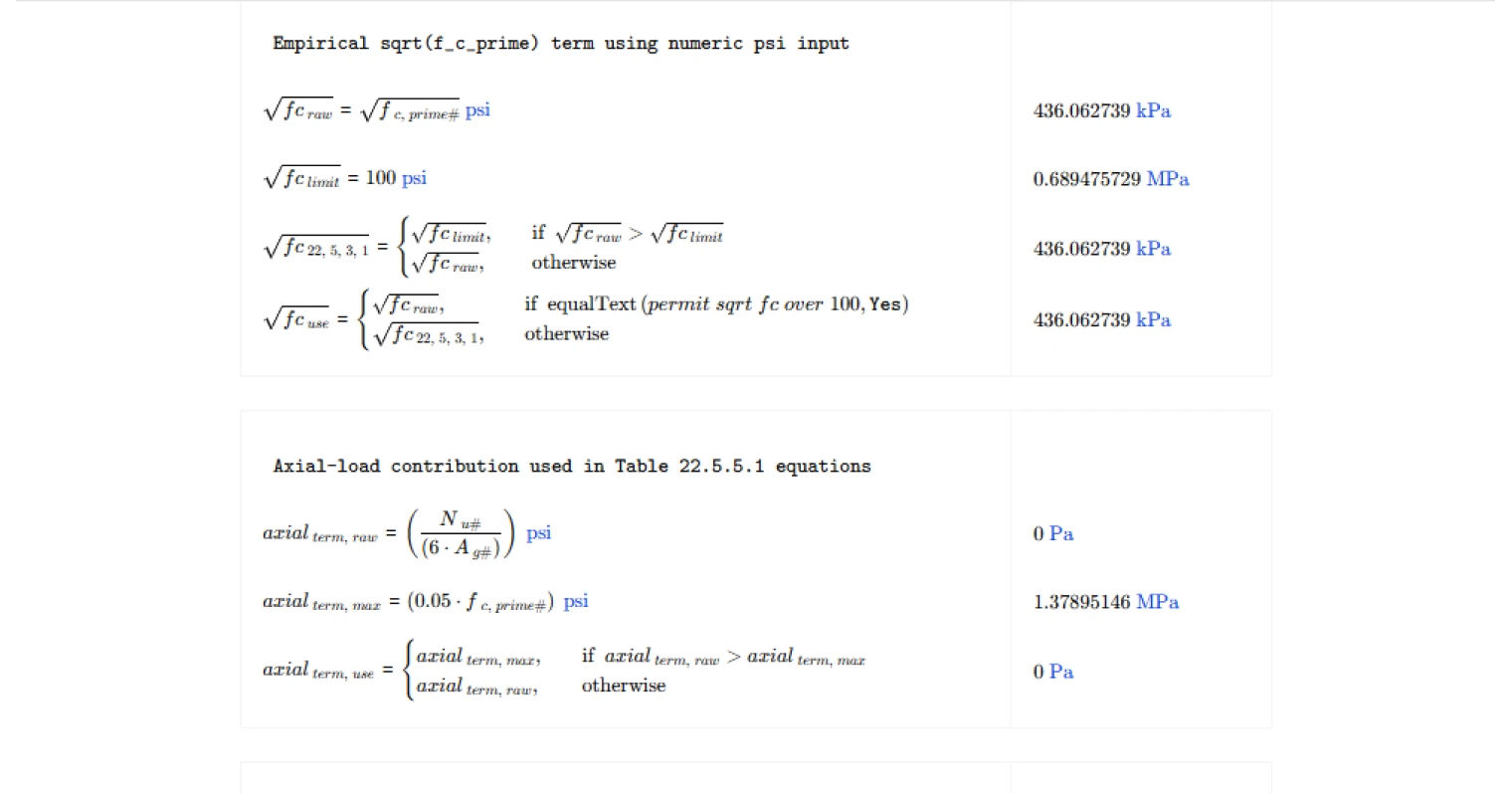
Several code limits are applied to ensure compliance with ACI provisions. The axial load contribution is capped relative to the compressive strength of concrete, and the square root of the compressive strength may be limited unless an alternate provision is permitted.
After computing the selected equation result, the calculator enforces the requirement that the concrete shear strength must not be negative and applies the code-specified upper bound on (V_c). The final result is reported along with a note indicating which limit or equation governs.
Common Calculation Errors to Avoid
- Ignoring the reinforcement condition for equation selection — the correct equation depends on whether the provided shear reinforcement meets the minimum requirement.
- Incorrect reinforcement ratio definition — the reinforcement ratio must be based on the longitudinal tension reinforcement relative to the web width and effective depth.
- Forgetting the axial load cap — the axial load contribution to shear strength is limited by the code and should not be used directly without checking the cap.
- Omitting the size-effect factor for deep members — when minimum shear reinforcement is not present, the size-effect modification must be included.
- Exceeding the code upper bound on shear strength — the calculated (V_c) must be checked against the maximum permitted value defined by the code.
- Allowing negative concrete shear strength — when axial tension reduces the calculated value, the code requires the concrete shear contribution to be taken as zero rather than negative.
Engineering templates
Common calculators
Design guides




FAQs
What is one-way shear strength Vc and why does ACI 318-19 provide multiple equations for it?
Vc is the nominal shear strength contributed by concrete alone, without shear reinforcement. ACI 318-19 Table 22.5.5.1 provides three equations because the governing mechanics differ depending on whether minimum shear reinforcement is provided. When Av >= Av,min, the concrete benefits from the crack-control effect of stirrups, so a simpler or reinforcement-ratio-based equation applies. When Av < Av,min, the size-effect factor lambda_s is introduced to penalize deeper members where diagonal tension failure is more brittle. Selecting the right branch is a design decision, not just a code formality.
What is the size-effect factor lambda_s and when does it matter?
Lambda_s accounts for the reduction in shear strength per unit area observed in deeper beams without minimum shear reinforcement. The formula is sqrt(2 / (1 + d/10)), with d in inches, capped at 1.0. It only applies to Eq. (c), the Av < Av,min branch. For shallow members (d <= 10 in), lambda_s = 1.0 and has no effect. For d = 20 in, lambda_s drops to about 0.82, reducing Vc noticeably. If your section lacks minimum stirrups and is relatively deep, this factor will govern the result.
How does the calculator handle the sqrt(f'c) cap from ACI 22.5.3.1?
Clause 22.5.3.1 limits sqrt(f'c) to 100 psi in one-way shear calculations unless the conditions of 22.5.3.2 are satisfied. This cap kicks in for f'c above 10,000 psi. The calculator applies the limit by default. If your mix design satisfies 22.5.3.2 (special testing and detailing for high-strength concrete), toggle the permit option to Yes and the raw sqrt(f'c) value will be used instead. The checks table flags when the raw value exceeds 100 psi so you know whether this matters for your inputs.
How is the axial-load term handled, and what does the clause 22.5.5.1.2 cap mean in practice?
The axial contribution to Vc enters as Nu / (6 * Ag), in psi units. Compression (positive Nu) increases Vc; tension (negative Nu) reduces it. ACI 22.5.5.1.2 caps this term at 0.05 * f'c, which prevents an unrealistically large axial benefit in highly compressed members. The calculator computes the raw axial term, checks it against the cap, and uses whichever is smaller. If the cap governs, the checks table shows a Fail flag and the capped value is used automatically in the Vc equation.
Which equation should I choose when Av >= Av,min — Eq. (a) or Eq. (b)?
Both are permitted by Table 22.5.5.1 when minimum shear reinforcement is provided. Eq. (a) is the simpler legacy-style expression using a flat coefficient of 2, independent of the longitudinal reinforcement ratio. Eq. (b) scales with rho_w^(1/3), which tends to give higher Vc for sections with reasonable reinforcement ratios (roughly rho_w > 0.6%). In practice, calculate both and use the one that gives the more efficient result. This calculator lets you select either equation via the radio input and shows all three raw values in the calculation block for comparison.
Why can Vc come out as zero, and what triggers the upper limit on Vc?
Two bounds apply after the selected equation is evaluated. The Note 2 floor sets Vc = 0 if the raw result is negative, which can occur under large net tension where the axial term drives the bracket below zero. The 22.5.5.1.1 upper limit caps Vc at 5 * lambda * sqrt(f'c) * bw * d, which prevents Eq. (b) or (c) from producing unconservatively large values in heavily reinforced sections. The governing note field in the summary tells you which limit, if any, controlled the final Vc so you can immediately see whether the selected equation or a code bound is driving the result.
Learn about the benefits of using CalcTree on engineering projects!