
Check ACI 318-19 minimum beam depth per Table 9.3.1.1 with fy and lightweight concrete modifiers. Get instant Pass/Fail results. Try the free CalcTree template.

Tell us what you need, or sign up and build it yourself in minutes.
Leave your email and we'll tell you when a template for it is ready:


No items found.
No items found.
About this ACI 318-19: Minimum Beam Depth - Nonprestressed Beams (Table 9.3.1.1) Calculator
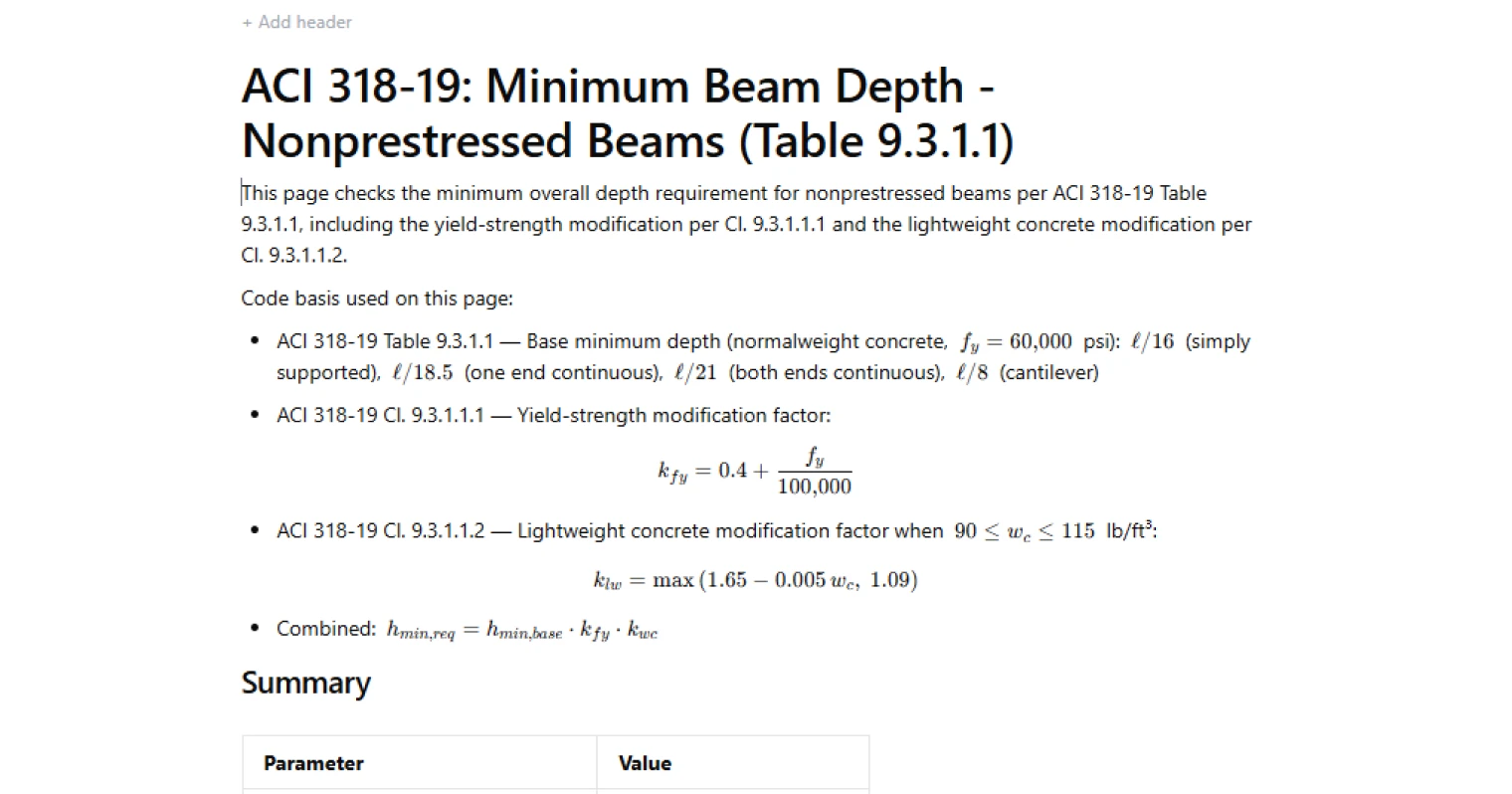
This calculator checks whether a nonprestressed beam meets the minimum overall depth requirements of ACI 318-19 Table 9.3.1.1. It applies the base span-to-depth ratios for all four support conditions, then adjusts for reinforcement yield strength per Cl. 9.3.1.1.1 and for lightweight concrete per Cl. 9.3.1.1.2, producing a single required minimum depth to compare against the provided section.
- Structural engineer — verify beam depth compliance during member sizing and quickly iterate on span, support condition, and material properties without manually tracking code modifiers.
- Project engineer — run a traceable, code-referenced depth check for documentation and design review submissions, with all intermediate factors visible.
- Engineering checker — audit the yield-strength and lightweight concrete modifications step by step to confirm the final required depth is correctly derived from first principles.
This is an engineering-grade calculator hosted on CalcTree, built directly from ACI 318-19 provisions with transparent intermediate values you can inspect, adapt, and save to a project workspace.
More info on ACI 318-19: Minimum Beam Depth - Nonprestressed Beams (Table 9.3.1.1)
Inputs
The calculator takes four inputs to fully define the check. The span length and provided overall beam depth are geometric inputs that drive the base depth calculation and the final pass/fail comparison. The support condition is selected from four options — simply supported, one end continuous, both ends continuous, or cantilever — and directly determines which span-to-depth ratio from Table 9.3.1.1 is applied. The reinforcement yield strength and concrete unit weight are material inputs that feed the two code modification factors. Together, these inputs cover all variables referenced in the relevant ACI 318-19 clauses.
Calculation Method
The calculation proceeds in three stages. First, the base minimum depth is taken from ACI 318-19 Table 9.3.1.1 by dividing the span length by the divisor corresponding to the selected support condition. Second, a yield-strength modification factor is computed per Cl. 9.3.1.1.1 to account for reinforcement with yield strengths other than the 60,000 psi baseline assumed in the table. Third, a lightweight concrete modification factor is applied per Cl. 9.3.1.1.2 when the concrete unit weight falls within the lightweight range defined by the code; outside that range, no modification is applied. The required minimum depth is then the product of all three terms: the base depth, the yield-strength factor, and the concrete weight factor.
Outputs and Design Check
The summary table presents all intermediate results alongside the final comparison. The base minimum depth, both modification factors, and the combined required minimum depth are shown explicitly so each step can be traced back to its code clause. The provided overall depth is compared directly against the required minimum depth, and a pass/fail traffic light confirms whether the section satisfies ACI 318-19 Table 9.3.1.1. A passing result means deflection calculations under ACI 318-19 Cl. 9.3.1 may be waived for that member, which is the practical benefit the table is intended to provide.
Scope and Limitations
This check applies specifically to nonprestressed beams where deflections are not explicitly calculated. It does not apply to prestressed members, flat slabs, or joists covered under separate ACI provisions. The lightweight concrete modification is only active when the unit weight falls within the range specified by Cl. 9.3.1.1.2; normalweight concrete above that range carries a factor of unity. The check also assumes the member qualifies as a beam under ACI 318-19 definitions and that the span length entered reflects the clear or effective span appropriate to the support condition selected.
Common Calculation Errors to Avoid
- Using the wrong support condition divisor — selecting simply supported instead of one end continuous, for example, produces a less conservative base depth and can result in a section that does not truly satisfy the code intent for its actual boundary conditions.
- Omitting the yield-strength modification for non-standard reinforcement — the table is calibrated to 60,000 psi steel, and using Grade 80 or other yield strengths without applying the Cl. 9.3.1.1.1 factor will understate the required depth.
- Applying the lightweight modification outside its valid unit weight range — the Cl. 9.3.1.1.2 factor only applies within the unit weight bounds specified by the code; using it for normalweight concrete inflates the required depth unnecessarily.
- Confusing clear span with center-to-center span — the span length entered should be consistent with how ACI 318-19 defines the applicable span for the support condition; mixing these up shifts the base depth result.
- Treating a passing result as a deflection guarantee — satisfying Table 9.3.1.1 allows deflection calculations to be waived under specific conditions, but it does not replace explicit deflection checks where serviceability requirements are more stringent or where the member falls outside the table's scope.
- Checking depth against d rather than h — the table and this calculation work with the overall section depth h, not the effective depth d; substituting d will give a non-conservative result.
Engineering templates
Common calculators
Design guides




FAQs
What does ACI 318-19 Table 9.3.1.1 actually control?
Table 9.3.1.1 sets minimum overall beam depths for nonprestressed beams to limit deflections without requiring explicit deflection calculations. If your beam meets these minimums, ACI 318-19 allows you to skip the detailed deflection check under Cl. 9.3.2. The limits apply only when the beam supports or is attached to construction likely to be damaged by large deflections — if that's not the case, deflection calculations are still required regardless.
When do the yield-strength and lightweight concrete modification factors apply?
The base table depths in ACI 318-19 Table 9.3.1.1 assume normalweight concrete (around 145 lb/ft³) and Grade 60 reinforcement (fy = 60,000 psi). If you're using a different yield strength, the k_fy factor scales the minimum depth up or down proportionally. If your concrete unit weight falls between 90 and 115 lb/ft³, the k_wc factor increases the required depth to account for the reduced stiffness of lightweight concrete. Both factors apply simultaneously when relevant.
What span length should I enter for continuous beams?
Use the clear span or center-to-center span consistent with how your structural model defines the member length. ACI 318-19 doesn't mandate a specific interpretation for this table, but center-to-center span is the common practice and gives a slightly conservative result. Be consistent with whatever span length you're using for moment and shear calculations on the same member.
Why does the cantilever condition produce a much larger minimum depth?
The l/8 limit for cantilevers reflects the fact that cantilevers have no redundancy — all deflection accumulates at the free end with no mid-span relief. A cantilever deflects significantly more than a simply supported beam of the same span and depth, so the code requires a much deeper section to keep deflections in check without explicit calculation.
What happens if my concrete unit weight is above 115 lb/ft³?
The lightweight concrete modification per Cl. 9.3.1.1.2 only applies when wc is between 90 and 115 lb/ft³. Above 115 lb/ft³, the calculation treats the concrete as normalweight and sets k_wc = 1.0. The base table depths already account for normalweight concrete, so no further adjustment is needed in that range.
What if my beam fails the minimum depth check?
If h_prov is less than h_min_req, you have two options: increase the beam depth to meet or exceed the minimum, or perform an explicit deflection calculation per ACI 318-19 Cl. 9.3.2 to demonstrate that deflections are acceptable. The second route requires more work but can be useful when architectural constraints limit available depth.
Learn about the benefits of using CalcTree on engineering projects!