
Check allowable axial strength for deep foundation members per ACI 318-19 13.4.2. Covers all 5 pile types. Run the free calc on CalcTree.

Tell us what you need, or sign up and build it yourself in minutes.
Leave your email and we'll tell you when a template for it is ready:





No items found.
No items found.
About this Deep Foundation Allowable Axial Strength Calculator
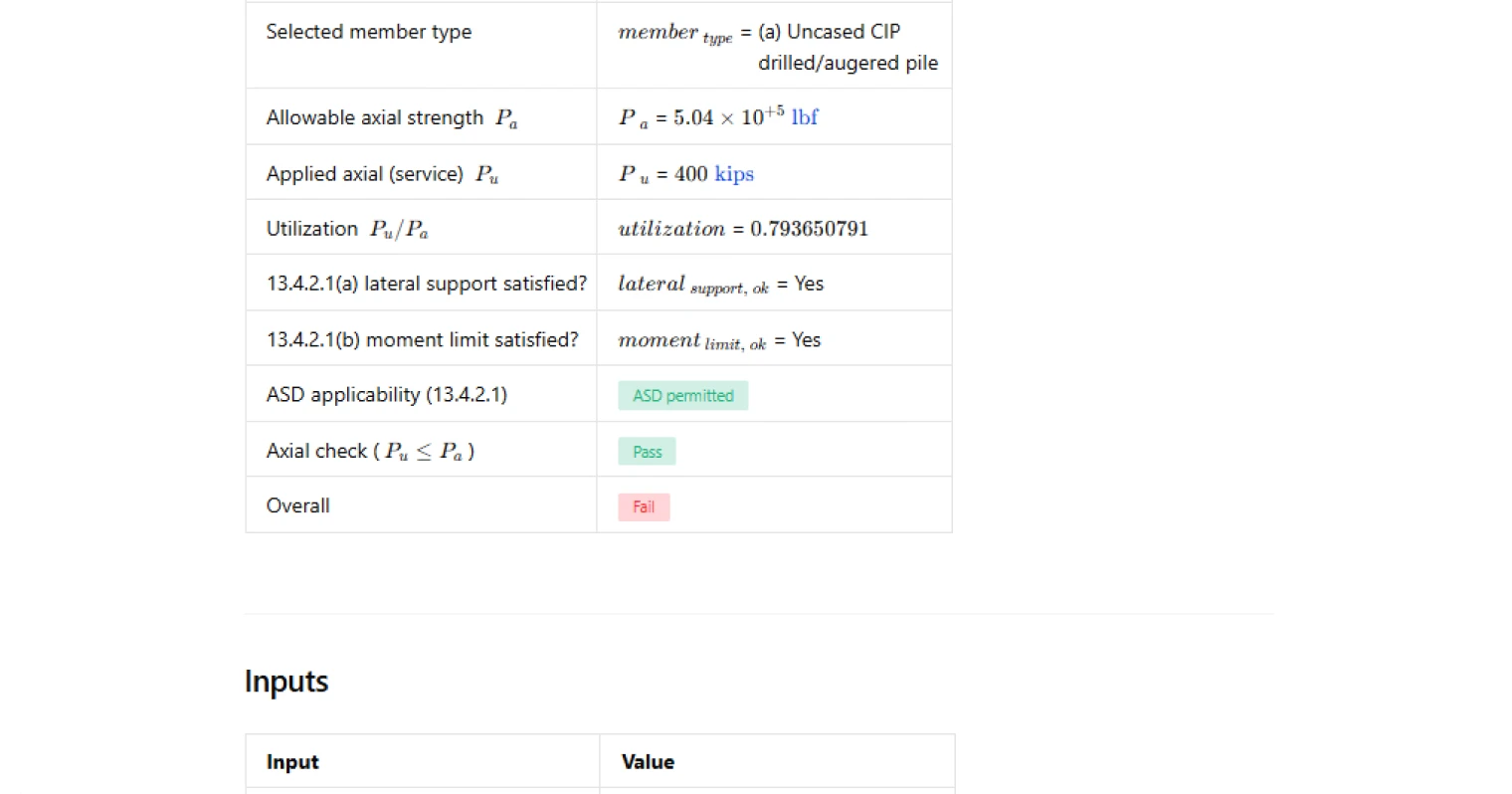
This calculator checks allowable axial compressive strength for deep foundation members using ACI 318-19 Section 13.4.2 (ASD). It selects the applicable Table 13.4.2.1 expression based on the member type, calculates the allowable axial strength (P_a), and compares it to the applied service axial load (P_u) to report utilization and pass/fail status.
- Geotechnical engineer — sanity-check that a selected pile type and reinforcement scheme is within ACI’s ASD axial compression limits before handing loads and pile schedules to the structural team.
- Structural engineer — verify (P_u \le P_a) for a pile member type and quickly see when the ASD path is not permitted and strength design per 13.4.3 is required instead.
- Detailer / civil designer — confirm the chosen deep foundation type (cased, uncased, precast, prestressed) aligns with the correct allowable stress expression and produces a clear utilization ratio.
This is an engineering-grade CalcTree calculator: it surfaces the code gate checks for ASD applicability, prints the governing table expression inputs/outputs, and packages the result as an auditable check you can reuse across projects.
More info on Deep Foundation Allowable Axial Strength
When ASD is permitted
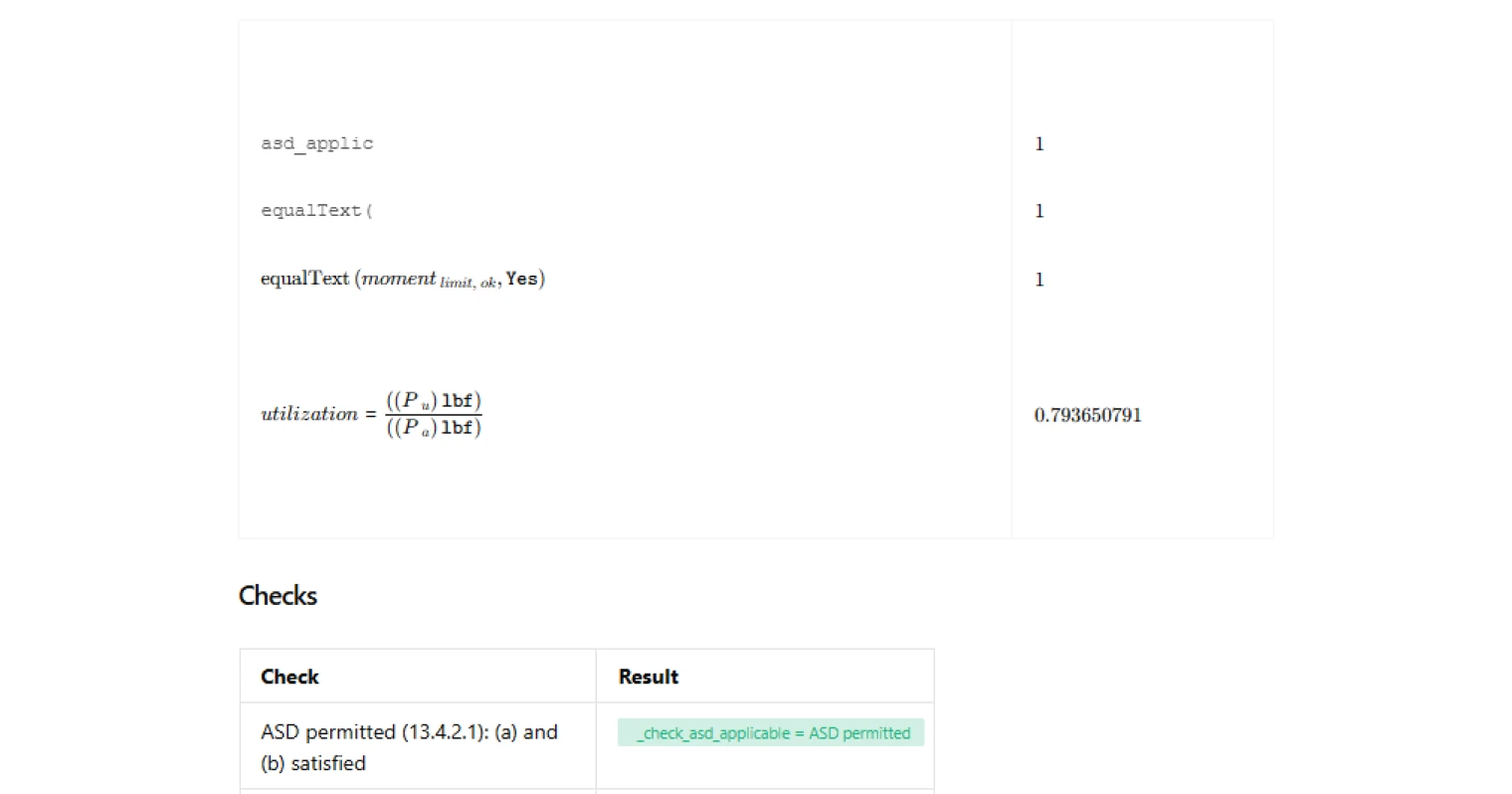
ACI 318-19 13.4.2 permits allowable stress design load combinations (ASCE/SEI 7 ASD combinations) only when both applicability conditions are satisfied: the deep foundation member is laterally supported for its entire height, and applied bending moments are less than the moment from an accidental eccentricity equal to 5% of the member diameter/width. If either condition is not satisfied, this page flags that ASD is not applicable and that design should proceed using strength design per ACI 318-19 13.4.3; it does not implement 13.4.3.
Member types and Table 13.4.2.1 expressions
The calculator uses the selected member type to apply the corresponding Table 13.4.2.1 allowable axial compression expression. Options cover uncased cast-in-place drilled/augered piles, cast-in-place piles in rock or permanent casing, metal-cased confined piles per 13.4.2.3, precast nonprestressed piles, and precast prestressed piles. Each option maps to a distinct (P_a) expression using gross area (A_g), nonprestressed longitudinal steel area (A_s) and yield strength (f_y), and where relevant for prestressed piles, prestressing area (A_{ps}) and service stress (f_{pc}).
Outputs and utilization checks
The primary outputs are the allowable axial strength (P_a), the applied service axial load (P_u), and utilization (P_u/P_a). In addition to the axial check (P_u \le P_a), the page reports whether the ASD applicability checks are satisfied. This separates “capacity is adequate” from “ASD method is permitted,” which is critical because failing the applicability gate requires switching to the strength design provisions rather than simply increasing section capacity within the ASD framework.
Implementation notes and modeling intent
The page treats (A_g) as the gross cross-sectional area as referenced by the table footnotes, and uses (A_s) as the nonprestressed longitudinal reinforcement area in the table expressions. If prestressed piles are not part of the design scope, select a nonprestressed member type so the calculation uses the nonprestressed expressions. The intent is a quick, transparent check aligned to ACI’s tabulated ASD limits for deep foundation members.
Common Calculation Errors to Avoid
- Skipping the ASD applicability gate — passing (P_u \le P_a) is not sufficient if either 13.4.2.1 condition is not met; the design route must switch to 13.4.3 strength design.
- Confusing service and factored loads — (P_u) here is a service/ASD load for allowable stress combinations; mixing in strength-level factored loads will distort utilization.
- Selecting the wrong member type case — cased vs uncased, “in rock/permanent casing,” and “confined per 13.4.2.3” change the allowable expression; verify the construction detail matches the selected table row.
- Misdefining (A_g) and (A_s) — (A_g) should be gross area and (A_s) should be longitudinal nonprestressed steel area consistent with the table; using net concrete area or including non-longitudinal steel can misstate (P_a).
- Applying prestressed terms to nonprestressed piles — the prestressed expression uses (f_{pc}) and (A_{ps}); if the pile is not prestressed, use the nonprestressed option rather than forcing prestress inputs.
- Treating “moment limit satisfied” as a vague yes/no — 13.4.2.1(b) is a specific comparison against the accidental eccentricity moment (5% of diameter/width); document how that check was established outside the calculator.
Engineering templates
Common calculators
Design guides




FAQs
What is ACI 318-19 Section 13.4.2 and when does it apply?
ACI 318-19 Section 13.4.2 covers allowable stress design (ASD) for deep foundation members under axial compressive load. It applies when two conditions are both met: the member is laterally supported for its entire height, and applied moments are less than those from a 5% accidental eccentricity of the member diameter or width. If either condition fails, the code redirects you to strength design per Section 13.4.3.
What are the five pile types covered by Table 13.4.2.1?
The table distinguishes: (a) uncased cast-in-place drilled or augered piles, (b) CIP piles in rock or within permanent casing not satisfying 13.4.2.3, (c) metal cased piles confined per 13.4.2.3, (d) precast nonprestressed piles, and (e) precast prestressed piles. Each has a different allowable strength formula reflecting the contribution of concrete and steel. Types (b) and (d) share the same expression but represent different construction methods.
Why does the prestressed pile formula subtract a term instead of adding one?
For precast prestressed piles (type e), the formula is Pa = 0.33f'cAg − 0.27fpcAps. The subtracted term accounts for the fact that prestress introduces compression into the concrete, reducing the additional axial load the member can carry before reaching its limit. This is a direct code expression, not a conservatism added by the template.
What happens if the ASD applicability check fails?
If either 13.4.2.1(a) or 13.4.2.1(b) is not satisfied, this template flags the ASD check as failed and stops. It does not compute an allowable strength for those conditions. Per ACI 318-19 13.4.2.2, you must instead use strength design in accordance with Section 13.4.3. The template is not a substitute for that check.
What load should I enter for P_u in an ASD calculation?
Enter the service-level axial load, meaning loads combined using ASCE/SEI 7 allowable stress design load combinations, not factored (LRFD) loads. Using factored loads will produce unconservative utilization ratios, since the allowable strength expressions in Table 13.4.2.1 are calibrated against service loads.
How do I confirm the moment limit condition (13.4.2.1(b)) before using this template?
You need to verify outside this template that applied bending moments on the pile are less than the moment resulting from a 5% eccentricity of the applied axial load relative to the member diameter or width. That threshold moment is M = Pu × 0.05 × D. If your pile head or connection details produce moments larger than this, select No for the moment limit input and use strength design instead.
Learn about the benefits of using CalcTree on engineering projects!