
Verify ACI 318-19 brackets and corbels dimensional limits (16.5.2) instantly. Check depth and max shear for NW/LW concrete. Run the free template now.

Tell us what you need, or sign up and build it yourself in minutes.
Leave your email and we'll tell you when a template for it is ready:




No items found.
No items found.
About this ACI 318 Bracket and Corbel Dimensional Limits Calculator
This calculator checks the dimensional requirements for reinforced concrete brackets and corbels in accordance with ACI 318-19 Section 16.5.2. It verifies key geometric limits and shear capacity restrictions to confirm whether a bracket or corbel configuration satisfies the code provisions before detailed reinforcement design.
- Structural engineer — quickly verify whether a bracket or corbel geometry satisfies ACI dimensional requirements before proceeding with full design checks.
- Concrete designer — confirm that the shear span, member depth, and shear demand fall within the allowable limits defined by the code.
- Engineering reviewer — validate that bracket or corbel assumptions meet ACI applicability requirements during design checks or peer review.
This is an engineering-grade calculator built for transparent verification of ACI 318 provisions. It exposes the governing limits and intermediate checks so engineers can clearly understand which conditions control the design.
More info on ACI 318 Bracket and Corbel Dimensional Limits
Applicability requirements
The calculator first verifies whether the bracket or corbel can be designed using the provisions of ACI 318 Section 16.5. These rules apply only when the shear span-to-effective-depth ratio does not exceed the specified limit and when the factored restraint force does not exceed the factored shear force. If either condition is violated, the member does not fall within the intended design scope of the bracket and corbel provisions.
Minimum depth at the bearing edge
ACI requires the overall depth at the outside edge of the bearing area to exceed a minimum proportion of the effective depth. This ensures sufficient compression strut capacity and provides adequate geometry for force transfer from the applied load to the supporting member. The calculator computes the minimum allowable depth and checks it against the user-defined geometry.
Maximum allowable shear demand
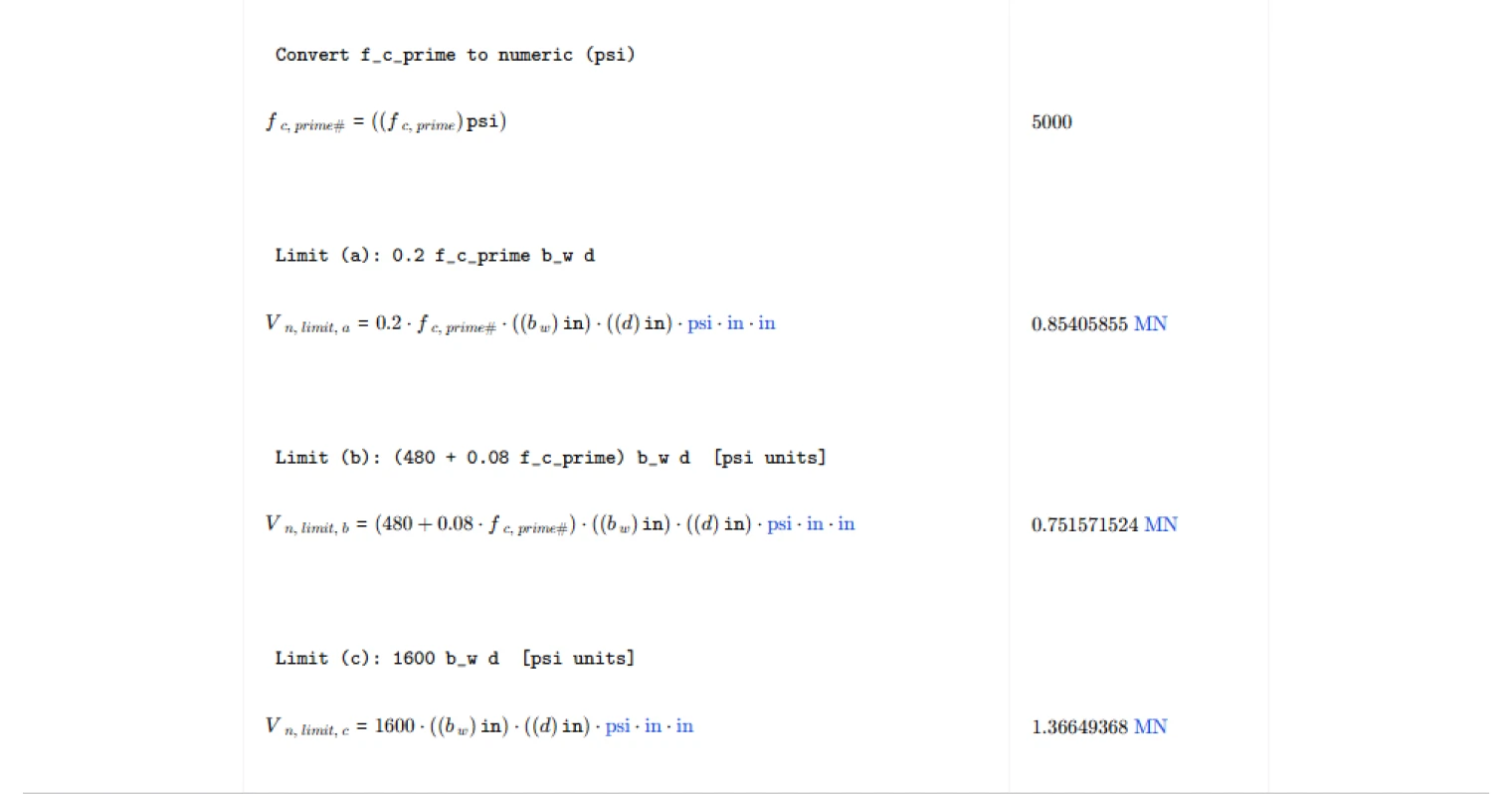
The code limits the maximum permissible value of the factored shear divided by the strength reduction factor. These limits depend on whether the concrete is normalweight or lightweight. The calculator evaluates all applicable limits defined in the code and identifies the governing value.
Concrete type selection
Different expressions apply depending on whether the bracket or corbel uses normalweight or lightweight concrete. The calculator automatically switches between the appropriate equations and evaluates the correct maximum shear limit based on the selected concrete type.
Common Calculation Errors to Avoid
- Ignoring applicability limits — The bracket and corbel provisions only apply when the shear span-to-depth ratio and restraint force limits are satisfied. Using the method outside this range can lead to unconservative results.
- Using the wrong concrete type — The allowable shear expressions differ for normalweight and lightweight concrete. Selecting the incorrect type can significantly change the allowable capacity.
- Overlooking the minimum depth requirement — The outside edge depth requirement ensures adequate compression strut development. Failing to meet this geometric condition invalidates the design assumptions.
- Misinterpreting shear limits — Multiple shear limits may apply, and the smallest value governs. Neglecting one of the limits may lead to an unconservative design check.
- Confusing nominal strength and design demand — The comparison should be performed between the factored shear divided by the strength reduction factor and the governing allowable shear limit defined by the code.
Engineering templates
Common calculators
Design guides




FAQs
What does ACI 318-19 Section 16.5.2 actually check for brackets and corbels?
Section 16.5.2 sets dimensional limits that must be satisfied before proceeding with a full corbel or bracket design. Specifically, it checks that the overall depth at the outside edge of the bearing area is at least half the effective depth (h ≥ 0.5d), and that the factored shear demand does not exceed upper-bound limits tied to concrete compressive strength and geometry. These checks exist to prevent brittle failures and ensure the strut-and-tie or shear-friction models used in the full design are valid.
What are the applicability conditions for ACI 318-19 Section 16.5.1.1?
Two conditions must both be satisfied for ACI 318-19 Section 16.5 to apply. First, the shear span-to-depth ratio a_v/d must not exceed 1.0, meaning the load is applied close enough to the support face for corbel-type behavior to govern. Second, the factored horizontal restraint force N_uc must not exceed the factored shear force V_u. If either condition fails, the element should be designed as a beam or deep beam under the relevant ACI provisions rather than as a corbel.
Why does the maximum shear limit differ between normalweight and lightweight concrete?
Lightweight concrete has lower tensile and shear strength than normalweight concrete of the same compressive strength, so ACI 318-19 applies stricter upper-bound limits. For normalweight concrete, three absolute limits are checked and the least governs (clauses a, b, c of 16.5.2.4). For lightweight concrete, the two limits in 16.5.2.5 are also functions of the shear span-to-depth ratio a_v/d, which accounts for the increased sensitivity of lightweight concrete to the moment-to-shear ratio at the critical section.
What inputs do I need to run this calculation?
You need concrete compressive strength f'_c, bracket width b_w, effective depth d, overall depth at the outside edge of the bearing area h, shear span a_v, factored shear force V_u, factored horizontal restraint force N_uc, strength reduction factor phi (typically 0.75 for shear), and concrete type (normalweight or lightweight). All dimensional inputs are in inches and force inputs in kips by default.
What should I do if the maximum shear strength check fails?
A failing shear check means the section size is insufficient and cannot be resolved through reinforcement alone. You need to increase the cross-sectional dimensions, specifically b_w or d, to bring V_u/phi below V_n_max. Increasing concrete strength f'_c will also raise the normalweight limits but has a diminishing effect since limit (c) of 1600 b_w d is independent of f'_c. Re-run the calculation after resizing to confirm all four checks pass before proceeding to reinforcement design.
Does this calculation cover the full corbel design per ACI 318-19?
No. This page checks only the dimensional limits under Section 16.5.2, which are prerequisite checks. A complete corbel design also requires calculating the primary tension reinforcement A_sc for combined shear-friction and moment, closed stirrups or ties A_h for horizontal force, and bearing area checks per Section 16.5.3 and 16.5.6. Use this page as the first step to confirm the geometry is viable before moving to the full reinforcement design.
Learn about the benefits of using CalcTree on engineering projects!