
Compute f'c, Ec, fr & λ per ACI 318-19 Cl. 19.2 instantly. Covers normal & lightweight concrete. Try the free CalcTree template now.

Tell us what you need, or sign up and build it yourself in minutes.
Leave your email and we'll tell you when a template for it is ready:



No items found.
No items found.
About this ACI 318-19: Concrete Design Properties (Cl. 19.2) Calculator
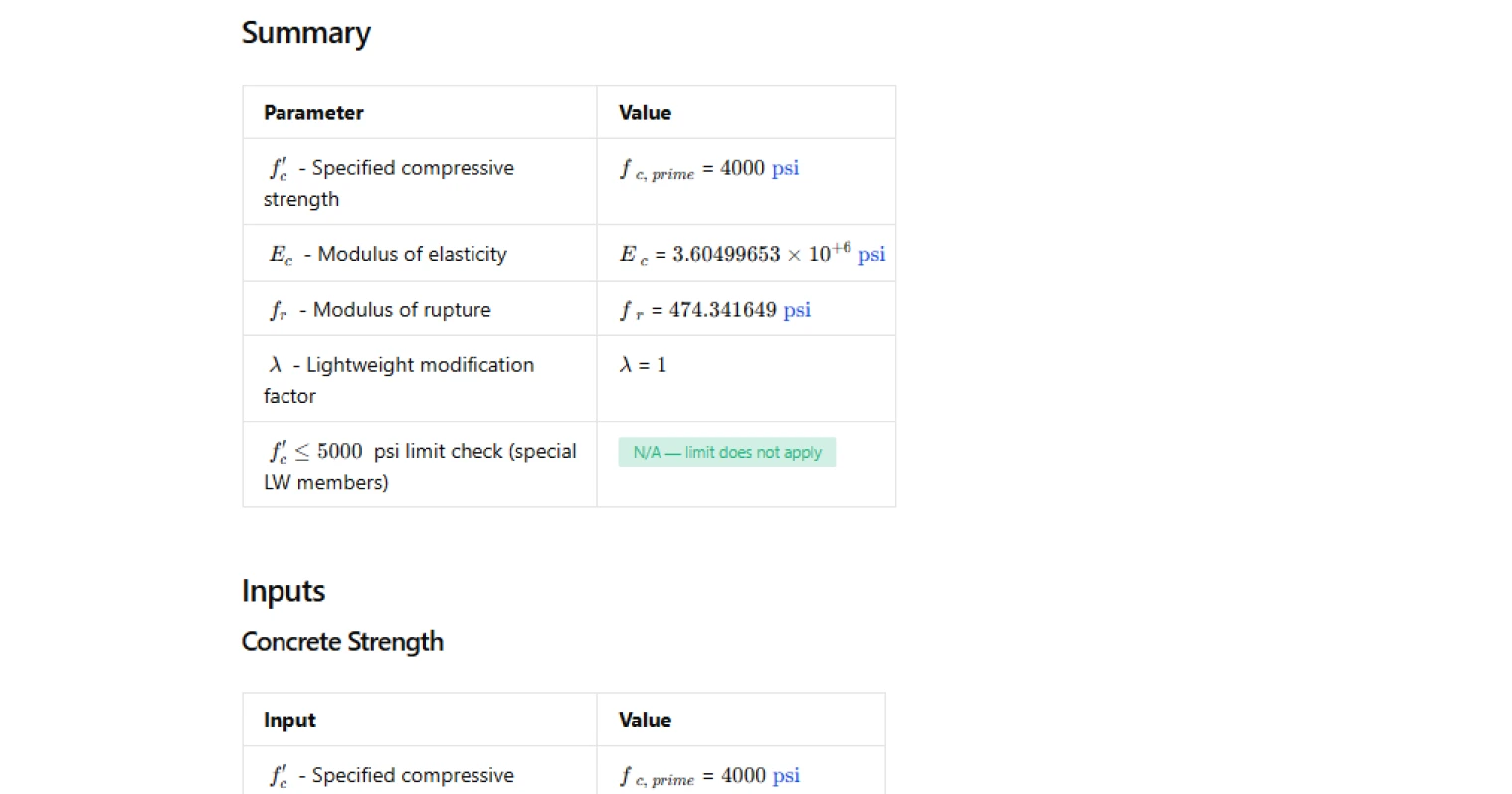
This calculator computes key concrete material properties for structural design per ACI 318-19 Chapter 19. Given a specified compressive strength and concrete type, it returns the modulus of elasticity, modulus of rupture, and lightweight modification factor, along with a code compliance check on the compressive strength limit for lightweight concrete used in special seismic systems.
- Structural engineer — pull concrete material properties directly into member design and deflection calculations without manually applying ACI equations each time.
- Engineer of record — verify that lightweight concrete used in special moment frames or special structural walls meets the upper compressive strength limit before advancing the design.
- Plan checker or reviewer — trace each output back to its ACI clause and confirm that the correct formula branch has been applied for the concrete type specified.
This is an engineering-grade calculator built on CalcTree, where every equation is visible, auditable, and linked to its code reference. Save it to a project workspace and connect it to downstream member design calculations.
More info on ACI 318-19: Concrete Design Properties (Cl. 19.2)
Inputs
The calculator takes two primary inputs: the specified compressive strength of concrete and the equilibrium density of concrete. You also select the concrete type, either normalweight or lightweight with a unit weight between 90 and 160 lb/ft³, which governs which formula branches are applied for the modulus of elasticity and the lightweight modification factor. A separate toggle captures whether the mix is being used in a special moment frame or special structural wall, which activates the compressive strength upper limit check under Cl. 19.2.1.1(d).
Concrete Material Properties Calculated
The calculator computes three material properties from the inputs. The modulus of elasticity is calculated using the general expression for concrete with unit weight in the specified range, or the simplified expression for normalweight concrete, per Cl. 19.2.2.1. The modulus of rupture is computed from the product of a constant, the lightweight modification factor, and the square root of the specified compressive strength, per Cl. 19.2.3.1. The lightweight modification factor follows Table 19.2.4.1(a): a fixed lower value for all-lightweight concrete below a unit weight threshold, a linear expression through the intermediate unit weight range, and unity for normalweight concrete or heavier lightweight mixes.
Design Check
A single code compliance check is performed on the specified compressive strength. Per Cl. 19.2.1.1(d), when lightweight concrete is used in special moment frames or special structural walls, the specified compressive strength must not exceed the code-prescribed upper limit unless the member's performance at higher strength is demonstrated by testing and analysis. The check is conditional — it only activates when the relevant toggle is set to Yes and the concrete type is not normalweight. When the limit does not apply, the check returns N/A rather than a misleading pass.
Outputs
The summary table collects all computed properties and the compliance check result in one place. These outputs feed directly into downstream calculations such as cracked and uncracked section analysis, deflection calculations, shear and flexural capacity checks, and seismic system design. Because CalcTree preserves the full calculation trail, any of these values can be linked by reference to other pages in the same project without re-entering inputs.
Common Calculation Errors to Avoid
- Using the normalweight formula for lightweight concrete — the simplified expression in Cl. 19.2.2.1(b) applies only to normalweight concrete. Applying it to a lightweight mix ignores the unit weight dependence and can significantly overestimate stiffness.
- Applying an incorrect lambda value — the lightweight modification factor is not a single fixed number for all lightweight mixes. It depends on equilibrium density and follows a stepped and linear relationship through Table 19.2.4.1(a); using 0.75 for a mix that qualifies for a higher value is unnecessarily conservative, while using 1.0 for a lightweight mix is unconservative.
- Forgetting the compressive strength cap for seismic applications — the upper limit on specified compressive strength for lightweight concrete in special moment frames and special structural walls is easily overlooked. Exceeding it requires test and analysis substantiation, not just a higher mix design.
- Mixing unit systems — the ACI empirical equations for modulus of elasticity and modulus of rupture are calibrated in psi and lb/ft³. Introducing values in ksi or pcf without conversion will produce incorrect results.
- Treating the modulus of rupture as a strength limit — the modulus of rupture is used for cracking moment and deflection calculations, not as a design flexural strength. Confusing it with tensile or flexural capacity leads to unconservative section behavior assumptions.
- Ignoring equilibrium density versus fresh unit weight — ACI 318-19 uses equilibrium density for the lambda and modulus expressions, not the fresh or air-dry unit weight. Using the wrong density value shifts both the modulus of elasticity and the lambda calculation.
Engineering templates
Common calculators
Design guides




FAQs
What concrete properties does this calculation produce per ACI 318-19?
The page computes four key design properties: specified compressive strength f'c, modulus of elasticity Ec, modulus of rupture fr, and the lightweight modification factor λ. These are the concrete material parameters required as inputs to most ACI 318-19 structural design checks for beams, columns, slabs, and walls.
What is the lightweight modification factor λ and how is it determined?
λ accounts for the lower tensile strength of lightweight concrete relative to normalweight concrete of the same f'c. Per ACI 318-19 Table 19.2.4.1(a), λ = 1.0 for normalweight concrete, λ = 0.75 for all-lightweight concrete (wc ≤ 100 lb/ft³), and λ = 0.0075wc (capped at 1.0) for equilibrium densities between 100 and 135 lb/ft³. Enter the concrete type and unit weight wc and the calculator resolves λ automatically.
Which Ec formula applies to my concrete — Cl. 19.2.2.1(a) or (b)?
It depends on concrete type. For normalweight concrete, the simplified form Ec = 57,000√f'c (psi) per Cl. 19.2.2.1(b) applies. For lightweight concrete with unit weight between 90 and 160 lb/ft³, the general expression Ec = wc^1.5 · 33√f'c (psi) per Cl. 19.2.2.1(a) is used. Select the concrete type in the dropdown and the correct formula is applied automatically.
When does the f'c ≤ 5000 psi limit apply and how is it checked?
ACI 318-19 Cl. 19.2.1.1(d) restricts lightweight concrete in special moment frames and special structural walls to f'c ≤ 5000 psi unless suitability is demonstrated by test data. This check only triggers when you select lightweight concrete and answer "Yes" to the special member prompt. The result shows Pass, Fail, or N/A depending on those inputs.
How do I use these outputs in downstream structural calculations?
Ec feeds directly into deflection, stiffness, and lateral analysis. fr is used in cracking moment calculations (Mcr = fr · Ig / yt) per ACI 318-19 Cl. 24.2.3.5. λ appears as a modifier wherever tensile concrete strength is relied upon, including shear, development length, and prestress checks. Copy the summary values into your member design templates as concrete material inputs.
What is the modulus of rupture used for in ACI 318-19 design?
fr is the theoretical tensile flexural strength of concrete and is not a direct material test value. It defines the cracking threshold for members under bending, used to compute Mcr for deflection control per Cl. 24.2.3, and in minimum reinforcement checks. It is always modified by λ, so lightweight concrete produces a lower fr and a reduced cracking moment compared to normalweight concrete at the same f'c.
Learn about the benefits of using CalcTree on engineering projects!