
Check the nominal axial strength of non-prestressed columns to ACI 318-19 Cl. 22.4.2.2. Free CalcTree template with inputs, design checks and outputs.

Tell us what you need, or sign up and build it yourself in minutes.
Leave your email and we'll tell you when a template for it is ready:


No items found.
No items found.
About this ACI 318-19: Nominal Axial Strength - Non-Prestressed Columns (Cl. 22.4.2.2) Calculator
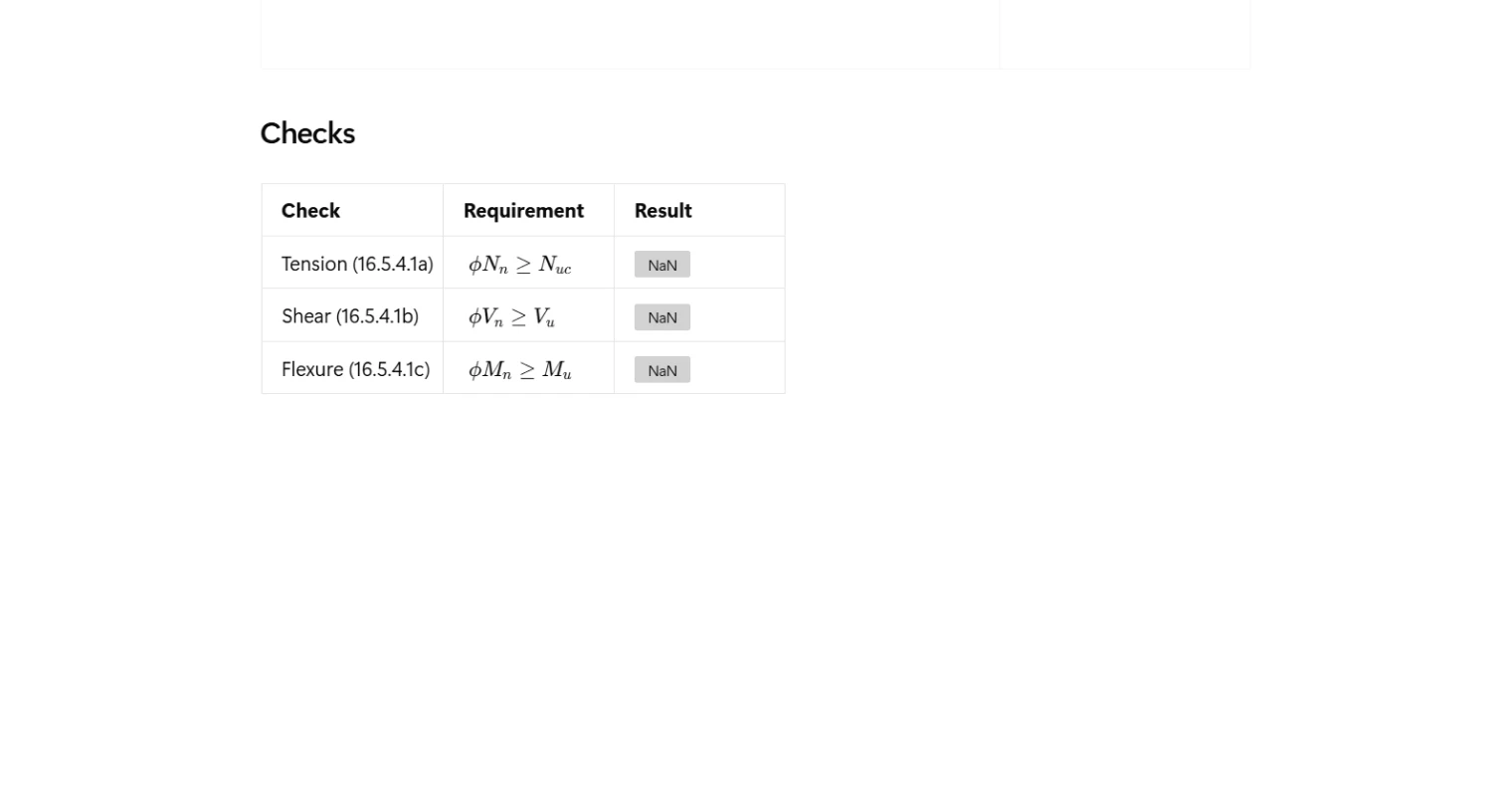
This calculator verifies the design strength of brackets and corbels per ACI 318-19 Section 16.5.4. It checks that factored resistance meets or exceeds factored demand for tension, shear, and flexure at all sections, confirming that φSn ≥ U across all three limit states. All three checks — φNn ≥ Nuc, φVn ≥ Vu, and φMn ≥ Mu — are evaluated and reported with pass/fail results.
- Structural engineer — verify bracket and corbel capacity against factored demands in seconds, with every intermediate strength value shown for design documentation.
- Reinforced concrete designer — iterate on reinforcement areas for tension and flexure, and confirm shear-friction capacity, without manually tracking clause references.
- Checking engineer — audit the applied strength reduction factor, demand inputs, and clause-by-clause checks to confirm compliance with ACI 318-19 Section 16.5.4.
This is an engineering-grade calculator built on CalcTree, where every clause reference, formula, and check result is traceable and exportable for project records.
More info on ACI 318-19: Nominal Axial Strength - Non-Prestressed Columns (Cl. 22.4.2.2)
Inputs
The calculator requires geometry, material, and demand inputs to fully define the bracket or corbel design problem. Material inputs include the specified yield strength of reinforcement. Geometric inputs include the effective depth of the bracket or corbel and the depth of the equivalent rectangular stress block per ACI 318-19 Section 22.2. Reinforcement inputs are split by function: the area providing tensile strength, the area providing flexural strength, and the nominal shear strength from shear-friction per Section 22.9, which is entered directly as a pre-calculated value. Factored demand inputs cover the tensile restraint force, the shear force, and the moment at the face of support. The strength reduction factor is also user-defined and should be assigned in accordance with ACI 318-19 Section 21.2.
Nominal Strength Calculations
The calculator evaluates nominal strength for each limit state using the applicable ACI 318-19 provisions. Nominal tensile strength is calculated per Clause 16.5.4.3 as the product of the tension reinforcement area and the yield strength. Nominal flexural strength is calculated per Clause 16.5.4.5 using the flexural reinforcement area, yield strength, effective depth, and stress block depth, following the design assumptions of Section 22.2. Nominal shear strength is taken directly from the shear-friction calculation per Clause 16.5.4.4 and Section 22.9, where the reinforcement crossing the assumed shear plane governs. Each nominal strength value is then multiplied by the strength reduction factor to produce the factored design strength used in the checks.
Design Checks
Three independent strength checks are performed per Clause 16.5.4.1. The tension check confirms that the factored tensile resistance meets or exceeds the factored tensile demand. The shear check confirms that the factored shear resistance from shear-friction is sufficient for the applied shear. The flexure check confirms that the factored moment capacity at the face of support covers the factored moment demand. Each check returns a clear pass or fail result with the computed factored capacity and demand displayed side by side, making it straightforward to identify which limit state governs and by what margin.
Outputs
The summary table collects the key results in one place: nominal tensile, shear, and flexural strengths, along with the traffic-light pass/fail status for each of the three design checks. This format supports fast design reviews and gives a complete picture of bracket or corbel performance against all three limit states in a single view. Results are presented in consistent US customary units throughout.
Common Calculation Errors to Avoid
- Misassigning the strength reduction factor — the φ value must be selected per ACI 318-19 Section 21.2 based on the controlling action; applying a value from a different section or a prior code edition will produce non-compliant results.
- Confusing tension and flexural reinforcement areas — An and Af serve distinct roles in Clauses 16.5.4.3 and 16.5.4.5 respectively; using the same area for both without checking the actual reinforcement layout will give unconservative or redundant results.
- Entering shear-friction capacity without completing the Section 22.9 check — Vn is taken as a direct input here, but it must be properly derived from the shear-friction provisions; skipping that step and entering an unchecked value bypasses a critical part of the design.
- Using the wrong effective depth — d should reflect the actual distance from the extreme compression fiber to the centroid of the tension reinforcement at the critical section; using the total section depth instead overstates flexural capacity.
- Neglecting to update the stress block depth when reinforcement changes — the depth of the equivalent rectangular stress block depends on the flexural reinforcement area and material properties; if Af is revised, the stress block depth must be recalculated before re-running the flexure check.
- Applying demands at the wrong location — Mu, Vu, and Nuc must correspond to the critical section at the face of support as defined by ACI 318-19; demands taken at a different reference point will not satisfy the intent of Section 16.5.4.
Engineering templates
Common calculators
Design guides




FAQs
What does this calculation actually check?
This page verifies that a bracket or corbel has enough design strength to resist the applied factored demands per ACI 318-19 Section 16.5.4. It runs three independent checks: tension (φNn ≥ Nuc), shear (φVn ≥ Vu), and flexure (φMn ≥ Mu). All three must pass for the member to be considered adequate.
What is the correct strength reduction factor φ for brackets and corbels?
Per ACI 318-19 Clause 16.5.4.2, φ is determined from Section 21.2. For shear-friction governed corbels and brackets, φ = 0.75 is the standard value used. The default in this template is set to 0.75, but verify this against your specific failure mode and reinforcement conditions.
How is nominal shear strength Vn determined for input into this template?
Vn is not calculated on this page. Per Clause 16.5.4.4, it must be calculated separately using the shear-friction provisions of ACI 318-19 Section 22.9, accounting for the area of reinforcement Avf crossing the assumed shear plane and the friction coefficient μ for the interface condition. Enter that pre-calculated value directly into the Vn input field.
What moment demand Mu should I use for the flexure check?
Mu is the factored moment at the face of the supporting member. It combines the moment from the applied vertical load (Vu acting at the shear span av) and the horizontal tensile force (Nuc acting at the height of the primary tension steel). Calculate Mu externally from your loading geometry before entering it here.
How is the depth of the stress block a determined?
The stress block depth a must be calculated outside this template using the standard rectangular stress block assumptions from ACI 318-19 Section 22.2, based on Af, fy, fc', and the section width b. Enter the resulting value directly into the a input field. The flexural strength Mn = Af · fy · (d - a/2) is then computed internally per Clause 16.5.4.5.
Can this template be used for both cast-in-place and precast corbels?
The ACI 318-19 Section 16.5 provisions apply to both, but the interface friction coefficient μ used in the shear-friction calculation (which feeds Vn) will differ depending on whether the interface is monolithic, intentionally roughened, or a cold joint. Make sure the Vn you input reflects the correct μ for your construction condition per Section 22.9.
Learn about the benefits of using CalcTree on engineering projects!