
Your product data, inside the engineer's workflow
We turn what you already publish into live calculations, datasets and skills. Then they are front and centre where engineers do their work and make decisions: in their AI assistant through our MCP server, in CalcTree and its plugins for Excel and Grasshopper, and on public pages you can embed anywhere.
Start the conversation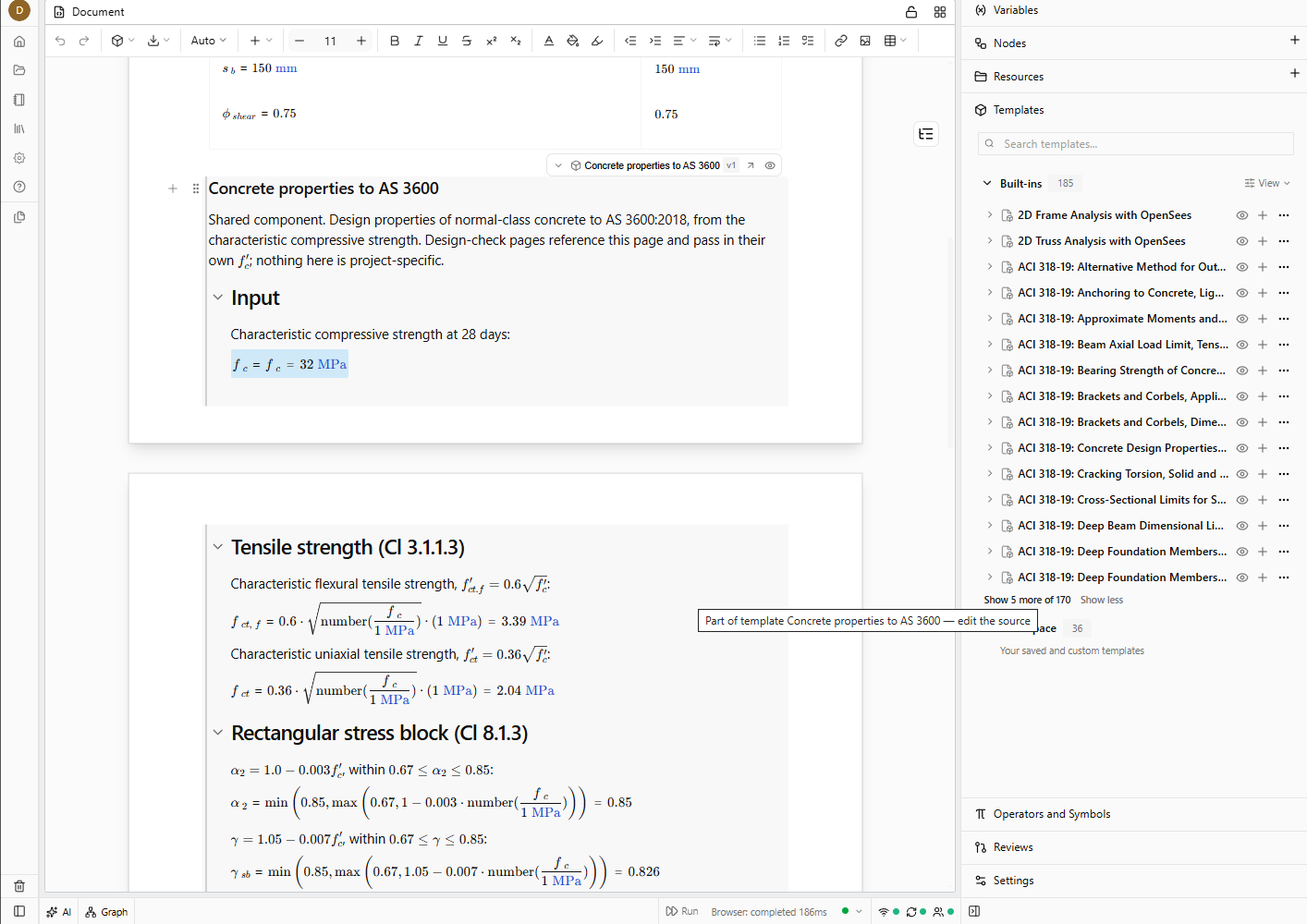
Calculations are built from the Australian Standards, Eurocode and ACI, covering Australia and New Zealand, the United Kingdom, Europe, the United States, India and Canada. Website and usage figures cover the 90 days to 19 November 2026, with internal traffic excluded.
The friction between an engineer and your product
Nothing in your literature is wrong. It is just a long way from where the work actually happens, and every step in between costs you something.

A detour every time
The answer is in a PDF in another window, or a call to your technical team.
Retyping breaks it
Values get copied by hand. Nothing ties them back to you, or to the edition.
Corrections never land
Revise a capacity. Every spreadsheet that copied the old one keeps using it.
The familiar wins
Engineers pick what they can defend in a review. A better product loses.
Built and managed by and for you
Two ways to do this, and both cover the upkeep as well as the build. We build and manage the components for you from the literature you already publish, and keep them current as the codes and your range change. Or we open a workspace for your own engineers, and they build, manage and control them themselves. Either way the result behaves the same once it is live.
Built from your literature
Your published design data, implemented as a component that shows its working. Your engineers review the method before anyone outside sees it.
Kept current
When a clause changes, or your range changes, the component is updated. No dev team, no technical debt and no stale calculator on your website carrying your name.
Engineers are told when your data changes
Components are versioned. Every engineer whose calculation references yours is flagged that a newer version exists, so nobody keeps quietly working from numbers you have withdrawn.
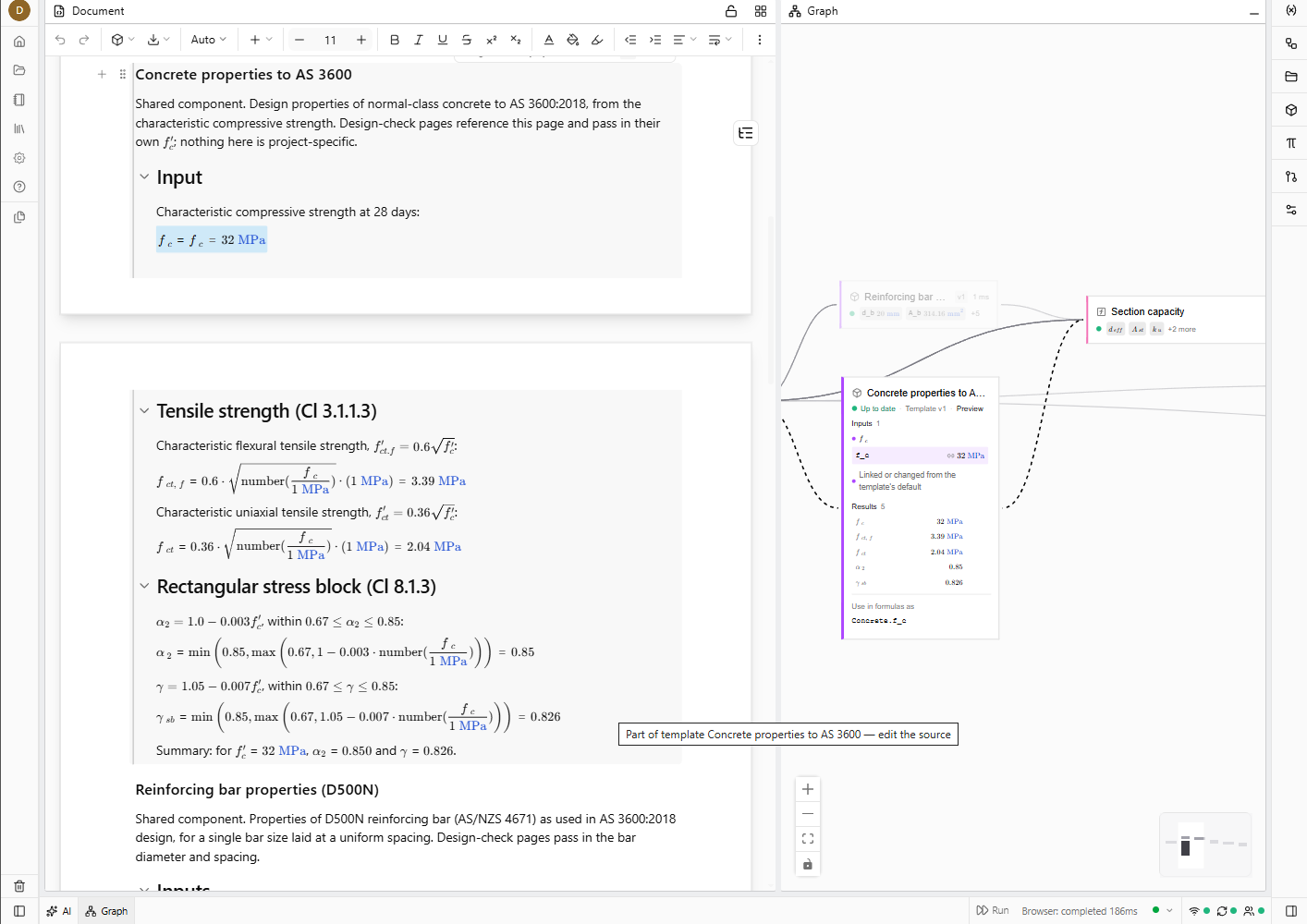
Not only calculations
Your technical knowledge is not one thing, and it does not all become the same object. This is the part the single-purpose calculator companies cannot do: we are not building you a calculator, we are making your product knowledge callable.

Your capacity tables and design guides, built on the relevant standard and citing the clause.
Runs it inside their own page, feeds the result into the member check, and prints it into the issued report with your product named.
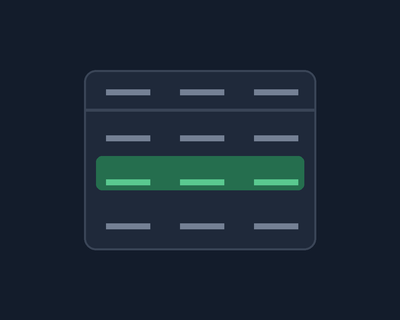
Your product ranges and property tables, addressable by name. We have already built these for the published section standards.
Picks your product from the range and its properties flow straight into the check, instead of being retyped off a page.

Your guidance documents, selection rules and test data, turned into context any AI connected to our MCP can call. For newer materials the codes do not cover yet, your test data is what engineers design from.
Asks their assistant, and your guidance is applied to the project in front of them with your product recommended for the right case.
All three are reachable the same three ways: on the CalcTree page itself, from the engineer's AI assistant through our MCP server, and from their own software through the API. A PDF has to be found and read by a person. These can be called by the workflow.
Engineers are already asking an AI. They just do not trust what it tells them.
Both halves of that decide whether your product data still gets used.
of technical buyers use generative AI in the purchasing process. Only 31% never do, down from 42% a year earlier.
how far they trust its answers. It was 6.5 in 2024, so confidence fell hard and has barely recovered.
say an AI summary in search is usually enough. The rest keep scrolling to find the source.
2026 State of Marketing to Engineers, ninth annual edition, GlobalSpec and TREW Marketing. Trust n=572, search summaries n=585.
Right now a frontier model answers questions about your products from whatever it scraped off the web. It can miss your literature, read an old edition, or quietly invent the bit it could not find. You have no say in any of it.
Put your data behind our MCP server and that changes. The assistant calls your components and gets an answer from data you control, with units and a clause behind it.
That solves the reach problem. The trust problem is the other half, and the same report ranks a generative AI tool last among the authors engineers trust, with an engineering expert at a vendor company first.
So the answer has to be auditable. The engineer opens the same component, sees the formula, the substituted values and the clause, and references it into their own page. They want to use AI, and they want to check what it handed them.
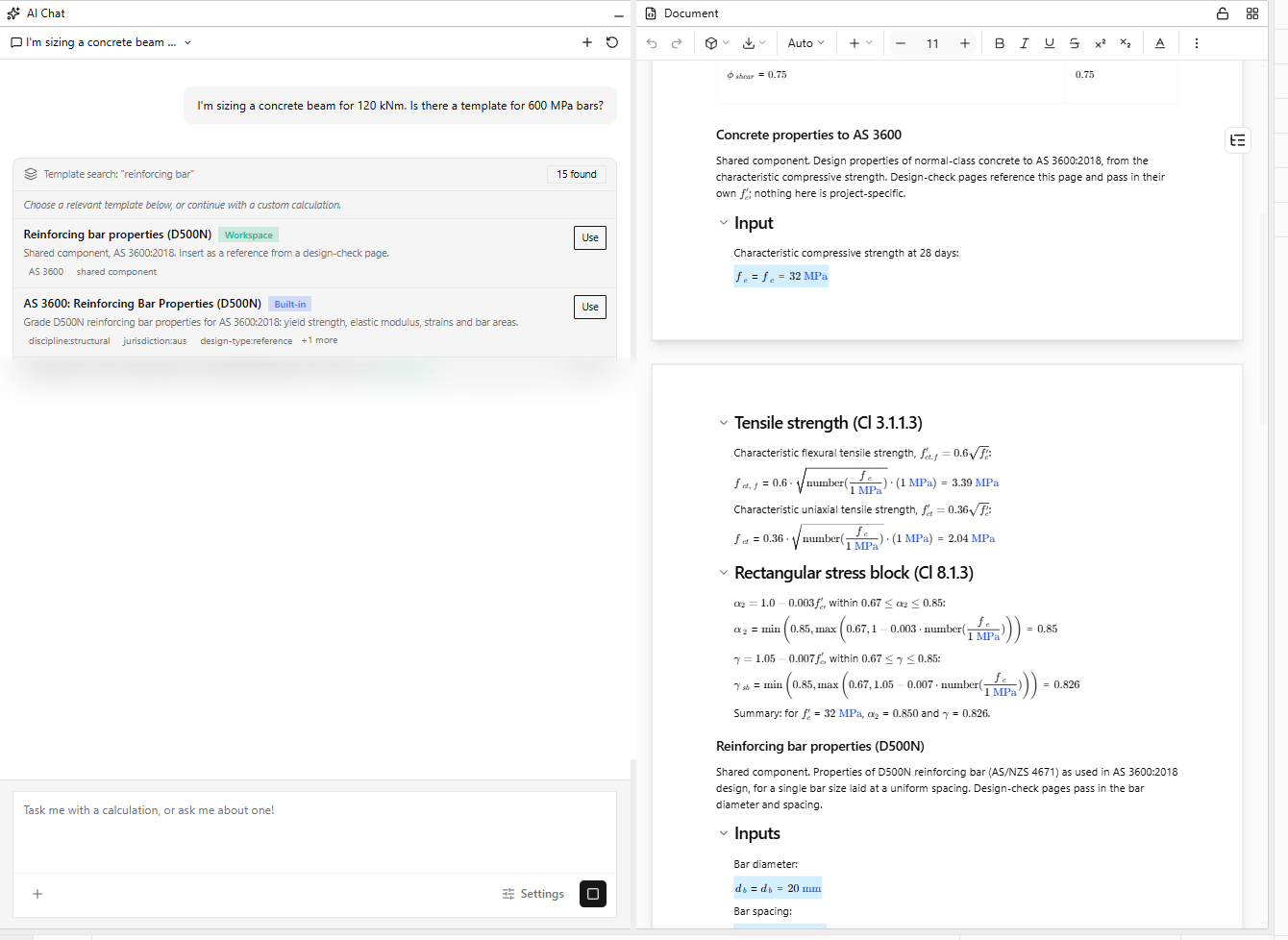
Asked in the engineer's own words. The component is one click from being in their calculation.
Why engineers will trust a calculation with your name on it
The obvious risk with a manufacturer's calculation is that it reads as marketing. An engineer who suspects that will not use it twice, and will never put it in front of a checker. So the whole thing is built to survive being examined.
The engineer sees the formula, the values substituted into it, the units, and the clause it came from. So does whoever checks the calculation before it is issued. Nothing about your product's capacity is a number anyone has to take on faith.
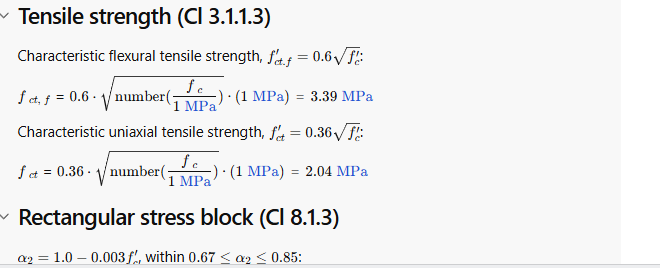
Nothing hidden.
Checkable line by line.
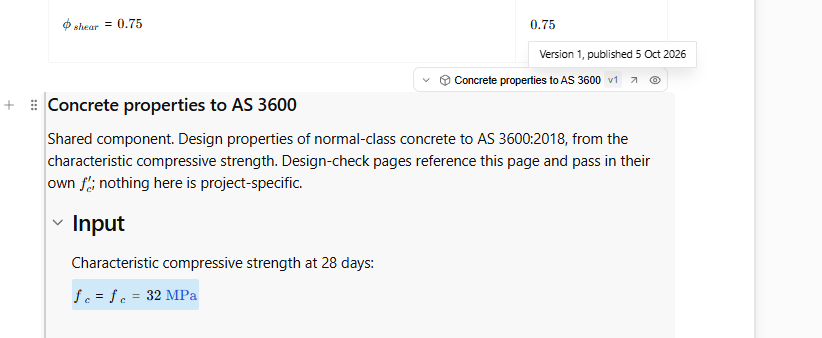
When a clause changes or you revise a capacity, we publish a new version. Pages already using it keep working and are told a newer version exists. Your correction reaches the engineers who specified you, which is the one thing a PDF on your website can never do.
Not a vendor microsite bolted on the side. It sits in the same library as the Australian Standards, Eurocode and ACI checks engineers already come here for, in the same format and reviewed the same way. Standards Australia is an investor in CalcTree.
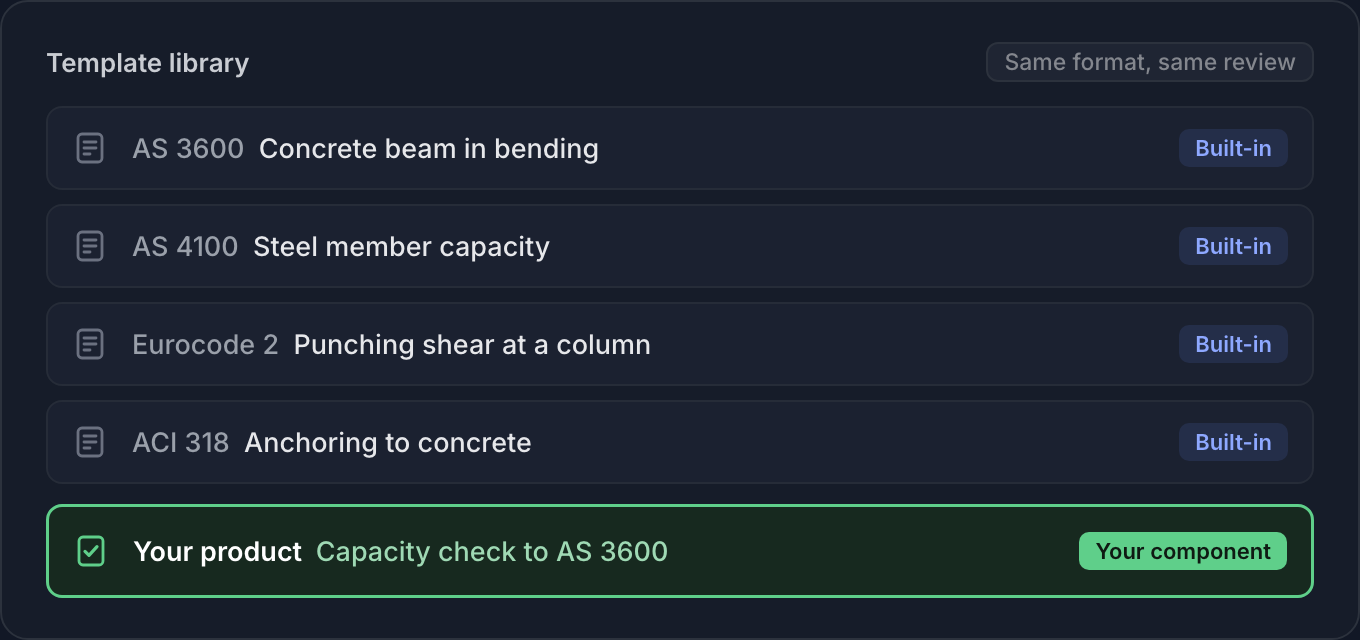
Built once, then everywhere engineers already work
A component is executable, not a picture of a calculation. Once it exists it runs in several places at the same time, so where it appears is a distribution decision rather than a development project.
In any AI connected to our MCP
The assistant calls your component and answers from data you control, rather than from whatever it scraped. This is the part nobody else in the category has built.
On a public page, embeddable anywhere
Each component gets its own page built to be found in search, and the same thing embeds into your product page, a distributor's site or a customer's project page.
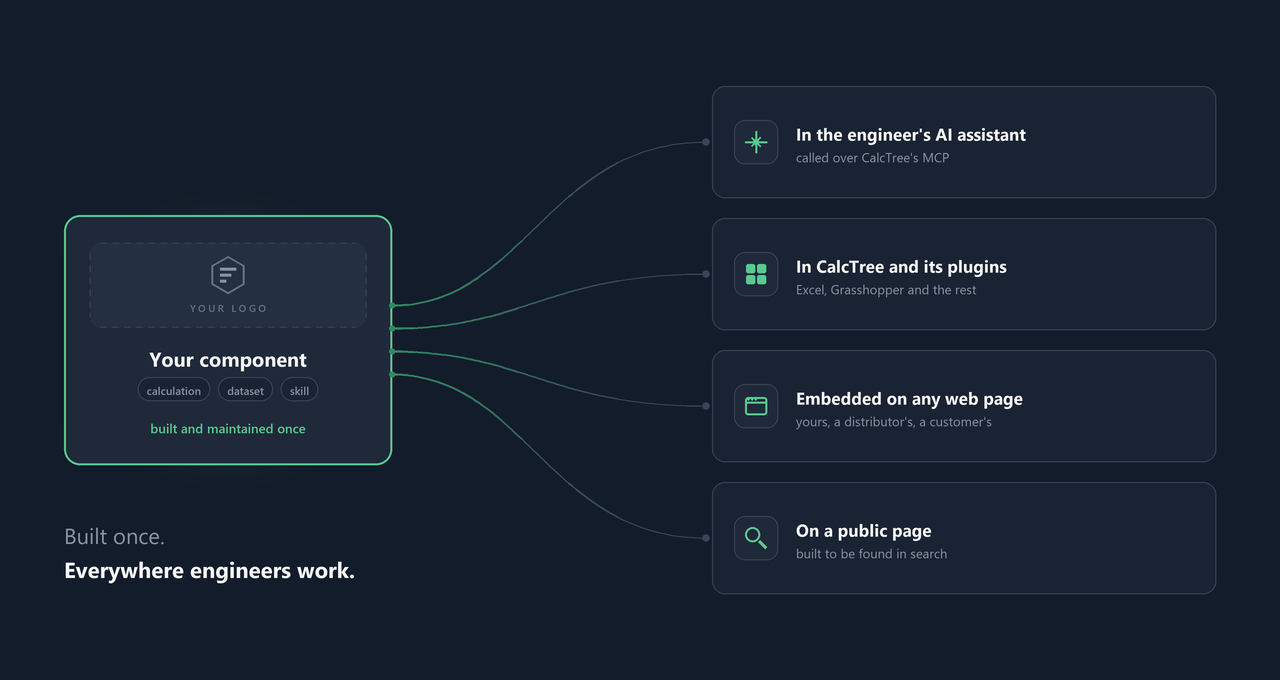
In the tools they already use
In CalcTree itself, and through the plugins engineers work in: Excel, Grasshopper and the rest. The same component, wherever their first pass happens.
Inside CalcTree AI
When an engineer builds from their own documents, CalcTree AI draws on the library, so yours is there to be reached for.
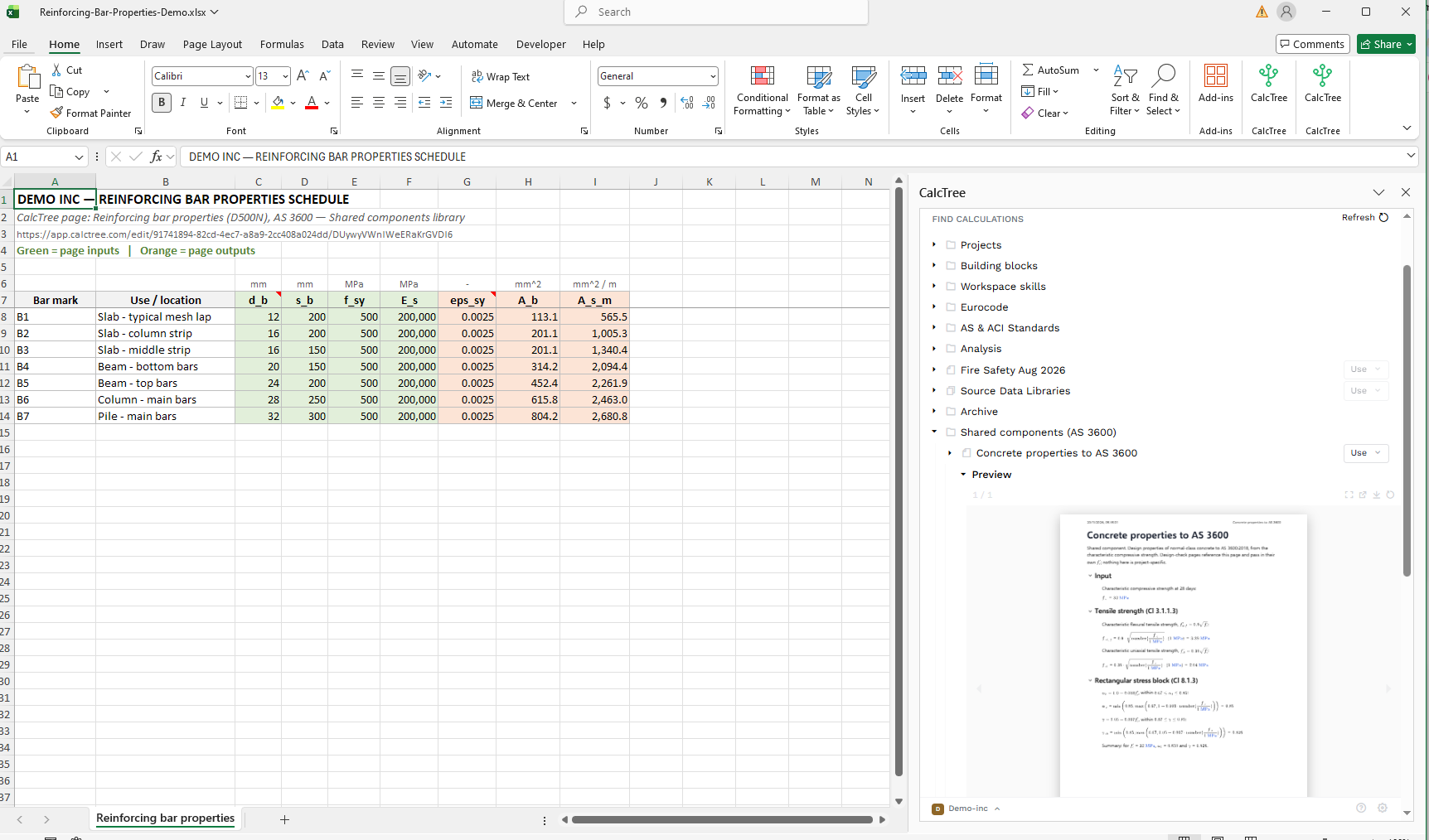
The same component, found and used from inside Excel.
All of it runs from one source, in a workspace you control or one we run for you. Change it there and every destination updates with it. There is never a second version drifting out of step.
Stop selling in the dark
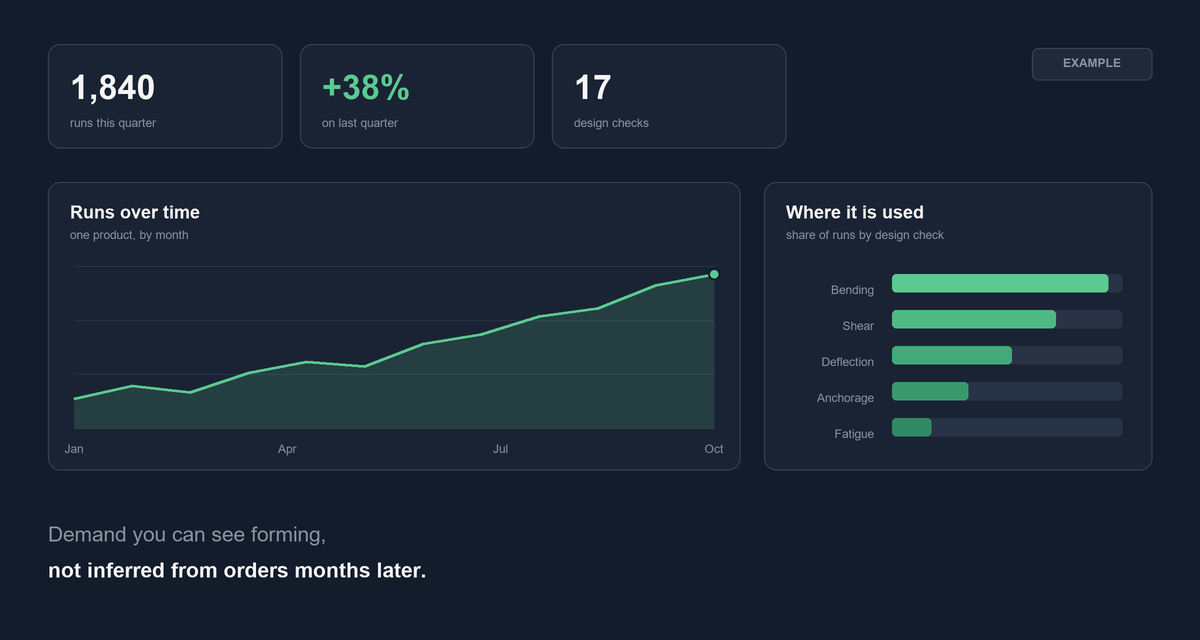
A specification decision is invisible to you until an order arrives, if it ever does. Once your components are in use you can watch the demand form instead of inferring it from sales months later.
See which products are gaining ground
Runs over time, by product and by design check, so you can see what engineers are actually reaching for.
Point your technical sales team
Know which checks your products are turning up in, and where interest is building, before anyone places an order.
Aim the next range at real demand
The checks engineers run most are the gaps worth filling. Let the usage inform the roadmap rather than the other way round.
Show what a launch did
Watch specification activity move after a launch or a campaign, rather than waiting on orders to tell you whether it worked.
Not only manufacturers
Your components sit alongside calculations built from the codes themselves, in a library engineers already trust. That association is worth as much as the reach.
Manufacturers
Anchors, cast-in channel, reinforcement, post-tensioning, geosynthetics, ground support, fixings, cladding, connectors. If an engineer opens your manual to size something, it belongs in a calculation.
Research bodies and universities
Design methods that are published but never implemented. A method engineers can run gets cited and adopted. One that stays in the paper does not.
Industry associations and test houses
Guidance documents, design aids and test data living as a PDF download. Guidance gets followed when it is the thing doing the arithmetic.
Questions we get asked
We already have a calculator. Why not just keep running it ourselves?
The build was the cheap part. Hosting, patching and a rebuild at every code revision are not, and the developer who built it has moved on. There is no IT to own here. We maintain it.
What does the MCP part mean in practice?
Right now an AI answers questions about your products from whatever it scraped. Through our MCP it calls your components instead, and the answer comes from what you actually published.
Do engineers have to pay to use it?
No. Everything we build for you works on a free CalcTree account, and anything published publicly is free for anyone. There is no paywall between an engineer and your product data, and no plan to put one there.
Who maintains it once it is live?
Whichever suits you. We can maintain it, or you hold the workspace and make changes yourself. Either way it is versioned, so engineers already using a component keep a working page and are told when a newer version exists.
What do you need from us?
The technical literature you already publish, and an engineer who can answer questions about it. Nothing confidential to start.
How long until it is live?
Three to six weeks, depending on scope. Most of the standards work already exists, so the time goes into your product rather than the code.
What does it cost?
There is no standard rate card. We scope the first components with you and commit to a price before you commit to anything.
Who owns what you build?
Your technical data stays yours, and everything carries your name and links back to your literature.
Start the conversation
Tell us which product the calculation would cover and we will come back with what it would take. One reply, nothing to book.
We will only use your details to reply about this. No newsletter, no list.